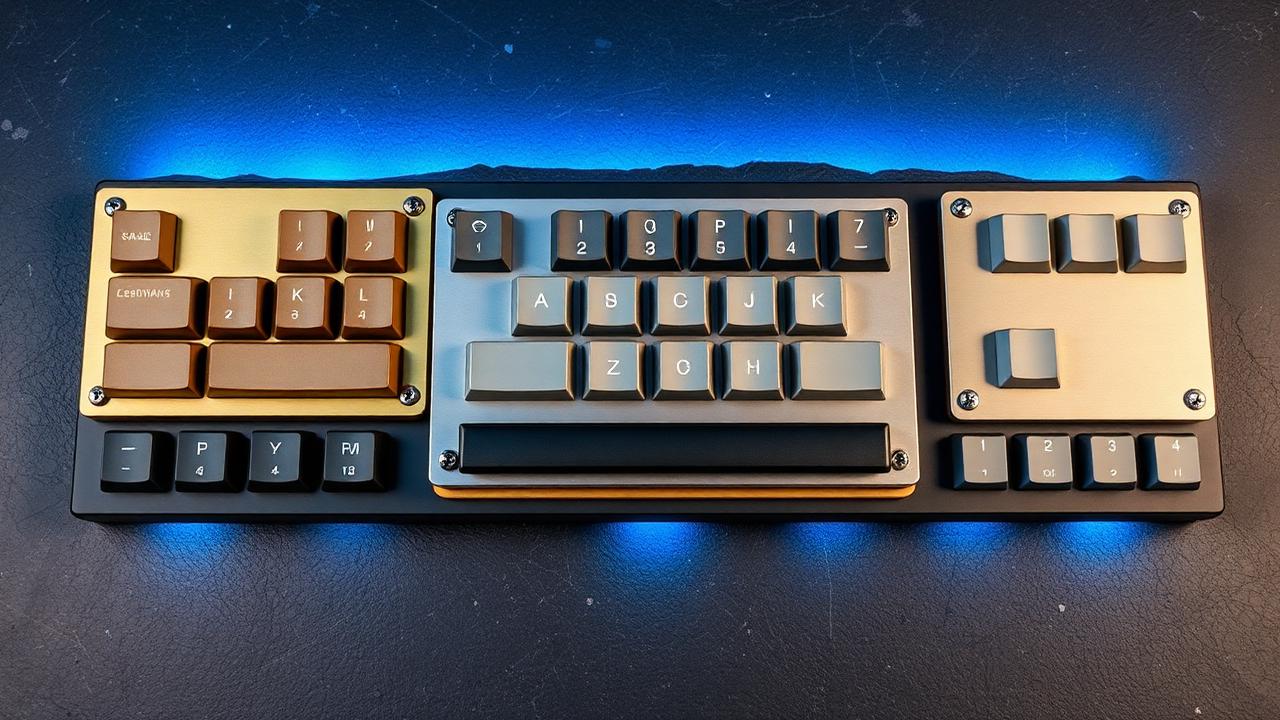
Three properties decide everything
A plate is a thin sheet with switch-shaped holes in it, and only three physical properties matter: stiffness, density and internal damping. Stiffness — technically the elastic modulus — determines how much the plate deflects under a given force. Density determines how much energy is needed to move it and how low its resonant frequency sits. Internal damping determines how quickly vibration in the material converts to heat rather than radiating as sound.
Metals are stiff and dense with almost no internal damping, so they ring. Plastics are compliant and light with high internal damping, so they thud. Composites such as FR4 sit in between by design. Once you internalise this, no plate material is mysterious: you can predict what an unfamiliar one will do from its datasheet numbers, and thickness lets you shift any material along the stiffness axis, since bending stiffness scales with the cube of thickness.
Brass and copper: heavy and bright
Brass is the stiffest and densest plate material in common use. It barely flexes at 1.5 mm, adds significant weight to the board, and produces a bright, high-pitched, resonant sound with a long tail. Builders who love it usually pair it with linears and thick PBT to keep the top end under control; builders who hate it describe it as clangy. It also tarnishes, which some people consider patina and others consider a maintenance chore requiring occasional polishing.
Copper behaves similarly but is denser still and even softer to machine, so copper plates are typically thicker and heavier again. Both metals push the board's resonant peak upward, which makes tactile switches sound sharper and clickier. If your existing board is already bright and thin-sounding, brass will make it worse, not better. If your board is dull and lifeless because of heavy foam and a soft plate, brass restores articulation immediately.
Aluminium and steel: the practical middle
Aluminium is the default for good reason. At 1.5 mm it is firm with a small amount of give, at 1.2 mm it flexes usefully, and its moderate density keeps the resonant peak lower than brass without going dull. It machines cleanly, anodises in any colour, and costs far less than brass. Most builders should start here and only deviate once they know which direction they want to move.
Steel is stiffer than aluminium at the same thickness and considerably heavier, with a characteristically sharp, metallic report. It was standard on older boards and remains common on budget prebuilts because it is cheap. It is rarely a first choice for enthusiast builds, though it suits people who want maximum rigidity and a crisp tactile experience without paying brass prices. Both metals need attention to plate foam, since neither damps itself.
POM, polycarbonate and nylon
Polycarbonate is the classic soft plate: noticeably flexible even at 1.5 mm, high internal damping, and a deep, muted, rounded sound. It suppresses the metallic top end almost entirely, which is exactly what people mean by a creamy or thocky board. The cost is articulation — heavily tactile switches lose some of their bite, and very fast typists sometimes find the plate's give makes bottom-out feel imprecise.
POM is slightly stiffer than polycarbonate with a distinctive marbly character and a naturally slippery surface that reduces switch-to-plate friction. It has become the enthusiast favourite for deep-sounding builds. Nylon sits close to POM in feel but is softer again and more prone to warping in thin sheets. All three are lighter than metal, which means the case itself contributes proportionally more to the final sound, so a plastic plate in an aluminium case sounds quite different from the same plate in a plastic case.
FR4, carbon fibre and choosing a combination
FR4 is the same woven glass-epoxy laminate used for PCBs. It is moderately stiff, well damped, cheap, and has a dry, neutral character that many builders describe as inoffensive in the best sense. It is an excellent default when you do not know what you want. Carbon fibre is stiffer and lighter with a very fast, snappy response and a dry, articulate sound, but it is expensive and the edges are unpleasant to handle unsealed.
For combinations, work backwards from the sound you want. Deep and muted: POM or PC plate, nylon or plastic case, minimal plate foam, linears with thick keycaps. Sharp and articulate: brass or aluminium plate, metal case, no case foam, tactiles. Balanced daily driver: 1.2 mm aluminium or FR4, gasket mount, thin poron plate foam. Use the dampening material calculator to size foam for your case volume and check switch clearance with the compatibility checker before ordering, since some box-style switches do not fit every plate cutout.
Thickness deserves a final word because it is the cheapest way to move any material along the stiffness axis. Bending stiffness scales with the cube of thickness, so a 1.2 mm plate is roughly half as stiff as a 1.5 mm plate of the same material, and a 1.0 mm plate is less than a third as stiff. That means a thin brass plate can flex more than a thick polycarbonate one, and it means you should never compare materials without comparing thickness at the same time. If a plate material you like is too stiff, order it thinner before abandoning it — you will usually keep the sound character while gaining the compliance you wanted.